OGDE

One Global Defence Ecosystem
Defend locally. Verify globally. Recover together.
A privacy-preserving, evidence-led foundation for interoperable cyber-defence.
MIT licence · Security policy · v0.3 plan · Engineering roadmap · CI history
[!IMPORTANT] Developer preview — not a production security control. v0.2.2 is the published baseline; v0.3 is under active development. Passing a unit test or verifying a digest is not proof that threat intelligence is correct, complete, fresh or publisher-authenticated. Do not rely on OGDE as your sole security control.
Mission
OGDE explores a neutral, locally governed cyber-defence ecosystem. Organisations retain control of their inventories and response decisions while sharing or consuming verifiable, reviewable intelligence through explicitly authorised interfaces.
The current engineering target is a small, demonstrable loop: intelligence → local matching → evidence-backed finding → human decision. WordPress installations and CI/CD dependency lockfiles are the first inventory targets. This is an experimental implementation, not an operational global threat-sharing network.
Architecture at a glance
The diagram below retains the same v0.3 review process, decision points and trust boundaries. Its presentation follows the restrained, monochrome PRISMA 2020-style flowchart convention (clear process boxes and explicit branches); it is an engineering workflow illustration, not a PRISMA systematic-review report. No system functionality is changed by this diagram.
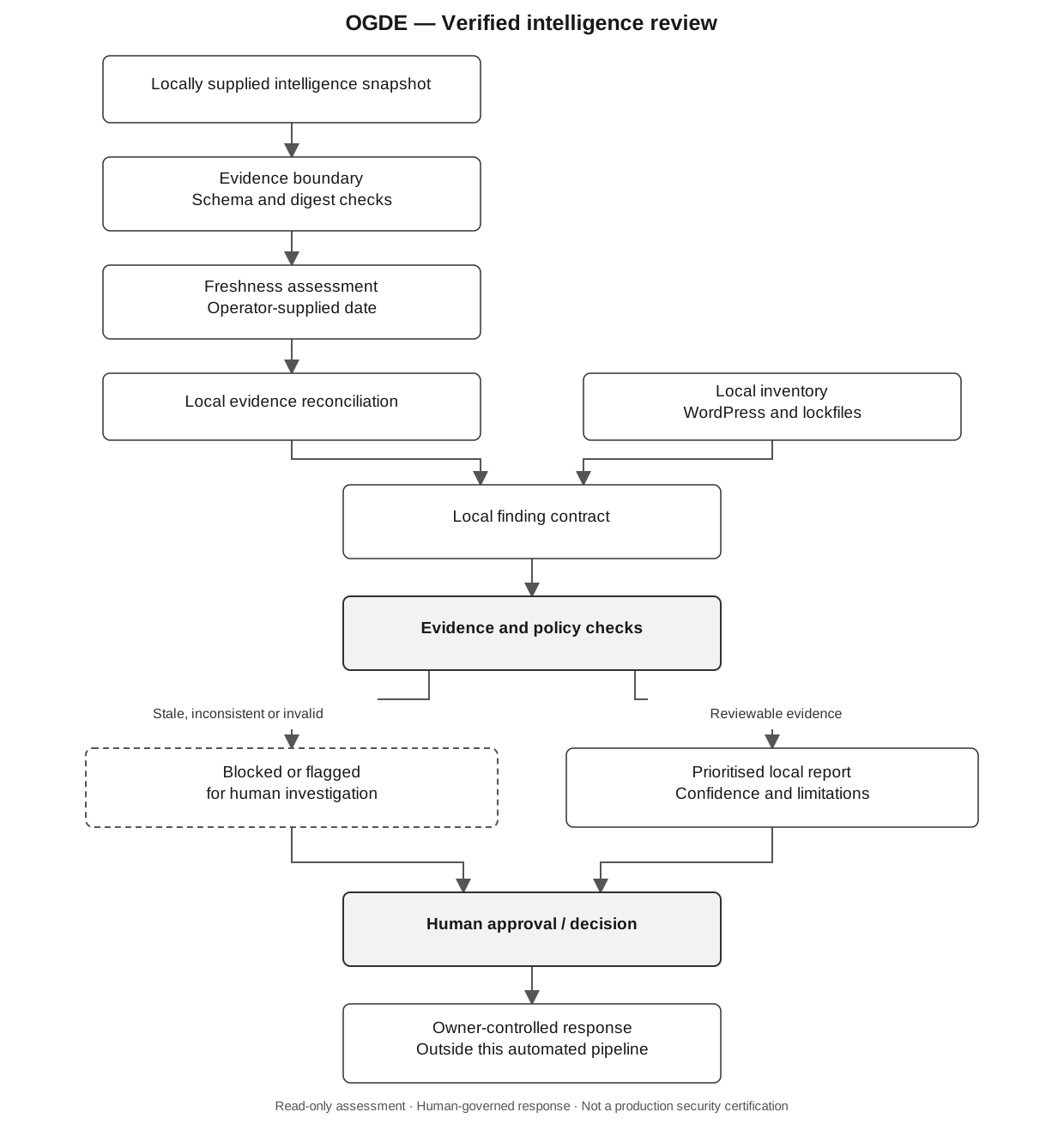
Open the full-size architecture diagram

Reading the flow: the left-hand local inventory and the checked intelligence evidence converge at the finding contract. Invalid or inconsistent evidence is flagged for investigation; reviewable evidence reaches a local report. Both paths require a human decision. No automated response is authorised.
Trust boundary: a matching SHA-256 digest demonstrates equality with a separately pinned digest; it does not authenticate CISA, prove feed freshness or establish that a local asset is vulnerable. Publisher authentication, asset applicability and remediation authorisation remain separate decisions.
Verified repository baseline versus work in review
| Capability | Status | What it actually does |
|---|---|---|
| v0.2.2 signed advisory assessment | On main |
Ed25519 verification, pinned keys, exact-version matching and local assessment. |
ogde inventory |
On main |
Local CycloneDX inventory from WordPress files, composer.lock and package-lock.json; no upload. |
ogde report |
On main |
Local finding validation, confidence and prioritisation, OpenVEX handling and audit output. |
| Evidence consistency and SHA-256 validation | On main |
Rejects malformed evidence digests and conflicting digest claims for the same evidence identity. |
| Offline KEV snapshot ingestion | On main / verify active revision |
Pinned-digest validation and a review-only ingestion receipt; no live CISA fetch. |
| KEV snapshot freshness policy | Draft PR #11 | Operator-dated, configurable age assessment; not publisher-authenticated. |
| Local KEV-to-finding reconciliation | Draft PR #12 | Flags mismatches between recorded KEV signals and a validated local snapshot; does not change findings. |
| Integrated KEV review pipeline | Draft PR #13 | Composes pinned ingestion, freshness and reconciliation into a human-review result; includes changes from the earlier draft branches. |
| TUF / Sigstore trust integration | Specification only | Not implemented or enabled. |
| Live multi-source intelligence, automated remediation, production agent | Not implemented | Not part of the current developer preview. |
Review note: the M3 draft branches overlap. Their pull requests are not independent production releases; review and reconcile the changes before merging. The table reports repository development state, not successful deployment or independently verified CI results.
Run the available baseline
Requires a supported Python environment. The commands below operate locally; the example findings are synthetic.
python -m pip install -e .
python -m unittest discover -s tests -v

mkdir -p .ogde-local

ogde inventory \
  --wordpress examples/demo-site/wordpress \
  --composer-lock examples/demo-site/composer.lock \
  --package-lock examples/demo-site/package-lock.json \
  --out .ogde-local/inventory.cdx.json

ogde report \
  --findings examples/findings.example.json \
  --vex examples/vex.example.json \
  --out .ogde-local/findings.json \
  --markdown .ogde-local/findings.md
ogde report intentionally exits with code 2 when a visible finding remains in the synthetic example. The historical odge command/import is retained as an alias; there is no separate implementation. See signed-feed documentation for the earlier verifier.
The new M3 modules are under review and are not advertised as stable CLI commands.
Security and privacy guarantees — and limits
- Local-first: inventories and findings remain on the operator’s machine by default.
- Explicit consent: network-enabled features require operator authorisation; the M3 offline pipeline makes no network requests.
- Read-only assessment: intelligence and advisory text are data, never commands.
- Fail closed: invalid schemas, mismatched pinned digests and inconsistent evidence must not silently become trusted findings.
- Human-governed response: no automatic patching, isolation, privilege escalation or production changes.
- Evidence honesty: signatures authenticate signers, not the truth of a vulnerability claim; KEV listing does not prove exploitation of a particular asset.
- Scope limitation: these are design and implementation properties of the described paths, not an independently audited platform-wide security certification.
Delivery gates and next work
The v0.3 exit gate is five pilot sites over four weeks and a published false-positive rate. This gate has not been met. Before any production-readiness claim, OGDE needs end-to-end integration tests, documented provenance and freshness policy, measured false positives, security review, and owner-approved pilot evidence.
Near-term engineering work: consolidate the overlapping M3 pull requests, verify GitHub Actions on the actual merge candidate, add structured local audit records and deterministic failure reporting, and evaluate authenticated source provenance. Longer-term milestones are in the autonomy roadmap.
Contributing and responsible disclosure
Read SECURITY.md before reporting vulnerabilities; disclose sensitive issues privately. Do not test against third-party infrastructure without authorisation.
Project: github.com/ymmiah/OGDE · Licence: MIT · Project phase: v0.3 experimental developer preview.